Apple Cuts Vision Pro Production, Pauses Marketing Push

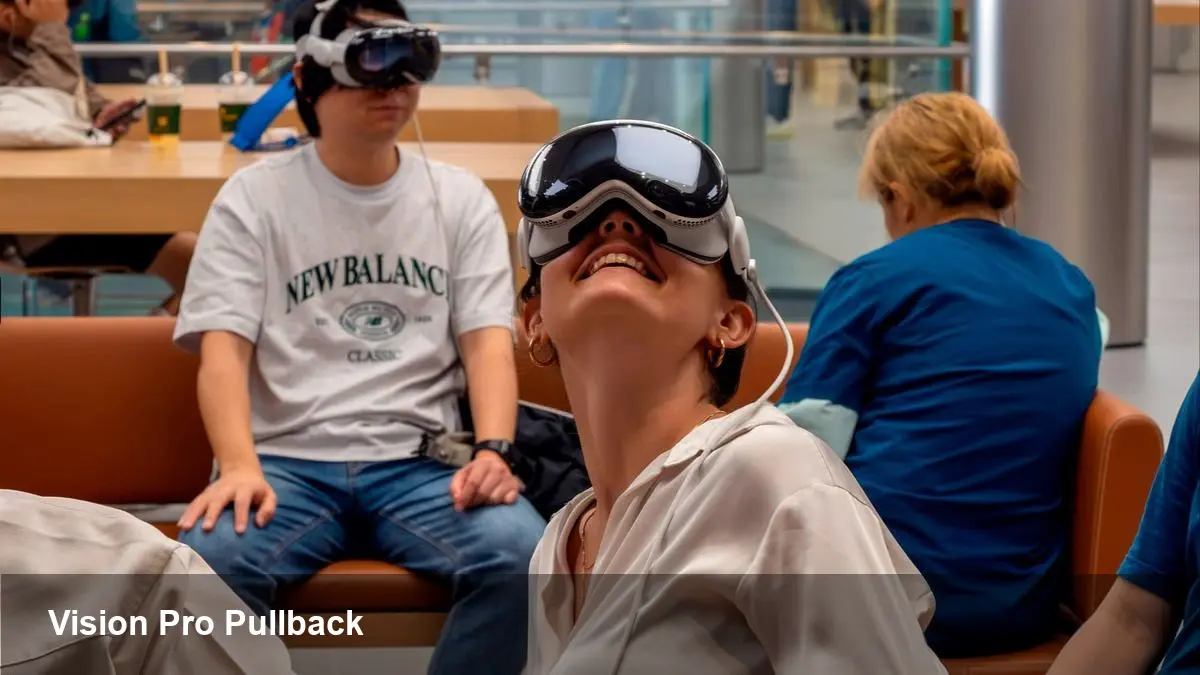
- Apple has scaled back production and reduced marketing for its Vision Pro headset after weaker-than-expected early demand.
- The mixed‑reality device, introduced at WWDC and priced at $3,499, faces a narrow early market because of cost and use‑case limitations.
- The move signals a short‑term course correction but not necessarily an end to Apple’s long‑term spatial computing ambitions.
What Apple has reportedly done
Reports say Apple has cut back Vision Pro production and pulled back some marketing activities following disappointing initial sales. The company has not published detailed public figures, but the adjustment reflects a more cautious near‑term approach to the product’s rollout.
Background: What is Vision Pro?
Apple unveiled the Vision Pro mixed‑reality headset at WWDC and launched it with a premium $3,499 price point. The headset combines Apple silicon with a dedicated R1 coprocessor to handle high‑bandwidth sensor data and spatial computing features.
Why sales may have been weak
Price is the most obvious barrier: at several thousand dollars, Vision Pro sits far above mainstream AR/VR headsets from Meta and others. That limits the pool of early adopters to affluent consumers and developers.
Beyond cost, the device faces ecosystem and use‑case hurdles. Developers are still building native spatial apps, and many mainstream consumers struggle to find daily reasons to wear a headset for extended periods.
Comfort, battery life, and the question of whether current content justifies the hardware have also been recurring themes in early reviews and user feedback.
Implications for Apple and the AR/VR market
A production and marketing pullback reduces near‑term volume for suppliers and dampens expectations for fast consumer adoption. Competitors such as Meta (Quest) and Microsoft (HoloLens) may respond with renewed price or enterprise pushes, though Apple’s premium positioning remains distinct.
Longer‑term strategy
Cutting production doesn’t necessarily mean Apple is abandoning the Vision Pro roadmap. Historically, Apple has invested years in categories—refining hardware, software, and developer tools before driving mass adoption.
A likely path forward includes focusing on developer tools, enterprise and creative pros who can justify the price, and incremental software updates to broaden everyday utility.
What to watch next
Look for official statements from Apple, signs of price incentives or trade‑in programs, and updates to visionOS and developer support. Watch supply signals from manufacturing partners and any shift toward enterprise sales or bundled services.
Apple’s Vision Pro experiment highlights how even well‑funded, high‑design launches can require patience and iteration before reaching a mainstream audience.