Run AI Agents Locally with AMD’s RyzenClaw and RadeonClaw

Why AMD is betting on local AI agents
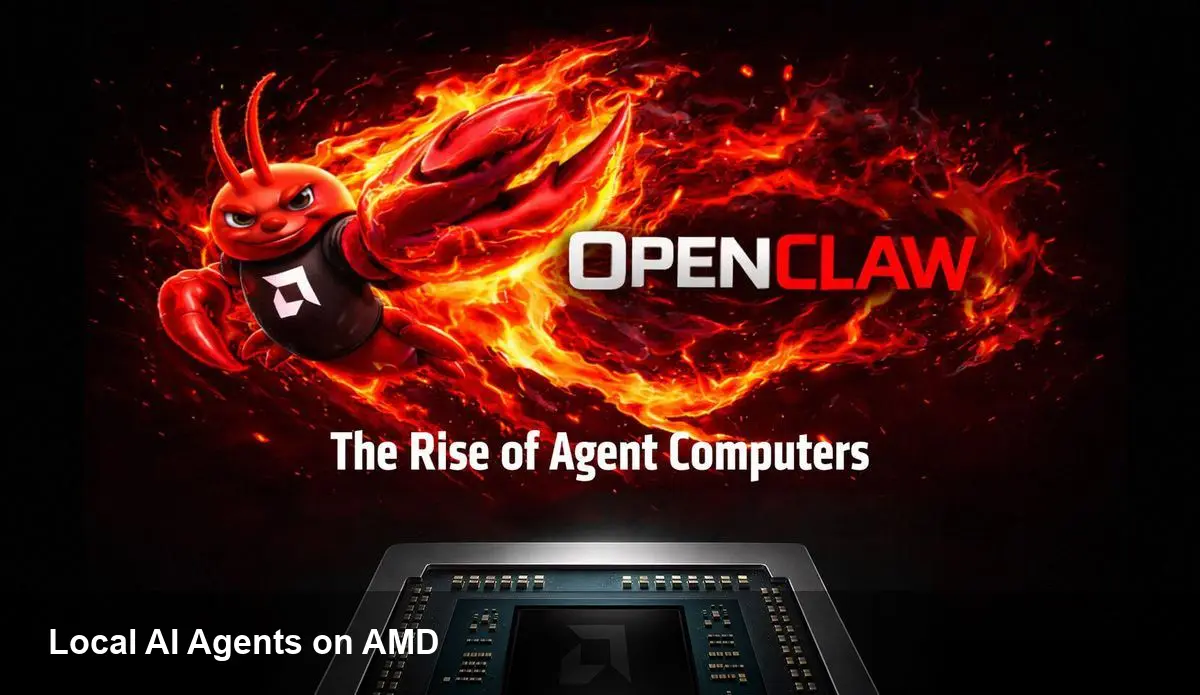
AMD has published a practical guide for running OpenClaw on Windows using two purpose-built hardware approaches: RyzenClaw and RadeonClaw. The company frames this work as part of a larger push to make personal computers capable of hosting autonomous AI agents without sending sensitive data to remote servers. For developers, enterprise IT teams, and device makers, that changes the calculus around latency, privacy and cloud dependency.
Quick company and tech background
AMD is a long-established CPU and GPU maker competing with the likes of Intel and NVIDIA. In recent years it has leaned into the idea that PCs should be more than thin clients for cloud models — they should be platforms capable of running sophisticated AI workloads locally. OpenClaw is the example agent runtime AMD demonstrates on Windows; RyzenClaw and RadeonClaw are two hardware/software stacks optimized around AMD’s CPUs and GPUs to accelerate those workloads.
What RyzenClaw and RadeonClaw actually are
- RyzenClaw targets systems built around AMD Ryzen processors and is tuned for CPU-heavy agent tasks and mixed CPU/GPU workloads. It emphasizes efficient use of multi-core x86 execution and inference libraries optimized for Ryzen microarchitectures.
- RadeonClaw leans on AMD’s discrete GPUs and integrated Radeon technology to accelerate large matrix operations and model inference that benefit from parallel compute.
Both paths are intended to let developers run OpenClaw-based agents on Windows machines entirely offline, giving you control over data, update timing, and network exposure.
Practical scenarios where local agents matter
- Knowledge workers: A developer or analyst can run a local code-assistant or document-summarizer that has full access to private codebases or corporate documents without uploading them to a third-party service.
- Field operations: Technicians working in remote locations with limited or costly connectivity can use an on-device agent for diagnostics or decision support.
- Compliance-focused deployments: Regulated industries (healthcare, finance, legal) can meet stringent data residency requirements by keeping inference on-premises.
- Personalized assistants: Users can have highly customized agents that learn from local files and preferences while keeping the training and inference cycles private.
What this means for developers and workflows
- Toolchain: Expect to integrate standard Windows tooling, AMD drivers, and AMD ML libraries or runtimes. Developers will need to validate models for quantization and hardware compatibility.
- Packaging: Agents will be distributed as model bundles plus runtime glue (OpenClaw runtime, model weights, any local data). Teams should design update channels that respect enterprise change control.
- Performance tuning: On RyzenClaw you’ll profile CPU thread usage and memory bandwidth. On RadeonClaw you’ll tune kernel launches, memory transfers, and use GPU-backed libraries for matrix math.
- Debugging: Local execution simplifies reproducing problems, but also requires local observability and crash handling — add telemetry that’s safe for private data.
Business advantages and cost considerations
- Lower operational cloud spend: Heavy inference on-device reduces per-inference cloud costs, which can be a major saving at scale.
- Differentiation for OEMs: Laptop and desktop makers can advertise “agent-ready” configurations tuned for local AI, potentially commanding higher margins.
- Faster interactions: Local agents reduce round-trip latency, making real-time assistant behaviors (like live code generation, voice interfaces, or AR overlays) feel immediate.
Costs to weigh: higher device hardware costs (more RAM, beefier GPUs), and engineering investment in local model management and security.
Limitations and practical hurdles
- Model size and memory: Cutting-edge models still demand lots of memory. RadeonClaw can help, but there are upper limits for on-device models without model compression or offloading.
- Fragmentation: A Windows-focused guide and AMD-specific optimizations mean cross-platform parity will need additional work for macOS or Linux and other silicon vendors.
- Update management: Keeping models and runtimes patched across thousands of machines is operationally different from centralized cloud updates.
- Ecosystem maturity: Tooling, debuggers, and model conversion flows for agent runtimes are improving but not universally polished yet.
Example: Deploying a private code-review agent
- Pick a model family and quantize weights for target memory constraints.
- Bundle model files with the OpenClaw runtime and a small local database of project artifacts.
- Ship to workstations configured as RyzenClaw or RadeonClaw depending on hardware.
- Use an internal update server that distributes new model weights and runtime patches under IT control.
- Monitor CPU/GPU utilization and tune thread pools or GPU kernels to hit desired latency and throughput targets.
This approach keeps code and diffs local while providing fast, developer-facing assistance.
What this move signals for the next few years
- More agent-first PCs: We’ll likely see OEMs create SKU tiers that explicitly call out agent capability, with bundled SDKs for ISVs.
- Hybrid orchestration: Expect software that dynamically decides whether to run a subroutine locally or fall back to cloud models based on privacy, latency, and load.
- Standard runtimes and packaging: The space will benefit from cross-vendor standards for agent packaging, model metadata, and secure update mechanisms.
How to evaluate if this fits your project
- Data sensitivity: If privacy is paramount, local agents are attractive.
- Real-time needs: For interfaces that require sub-100ms response, local execution is a strong win.
- Scale and maintenance: If you’re deploying to thousands of machines, factor lifecycle management into your TCO model.
AMD’s documentation and examples give a practical on-ramp for teams willing to invest in local agent infrastructure. For organizations that can afford the upfront complexity, RyzenClaw and RadeonClaw — and the broader agent-computer idea — unlock new tradeoffs between control, cost, and speed that are hard to achieve with cloud-only approaches.
Whether you’re an app developer looking to ship a privacy-first assistant, an OEM defining next-gen laptop features, or an IT team balancing compliance and productivity, experimenting with on-device agents is worth adding to your roadmap.