OpenAI’s Shocking ‘God AI’ Business Plan Revealed

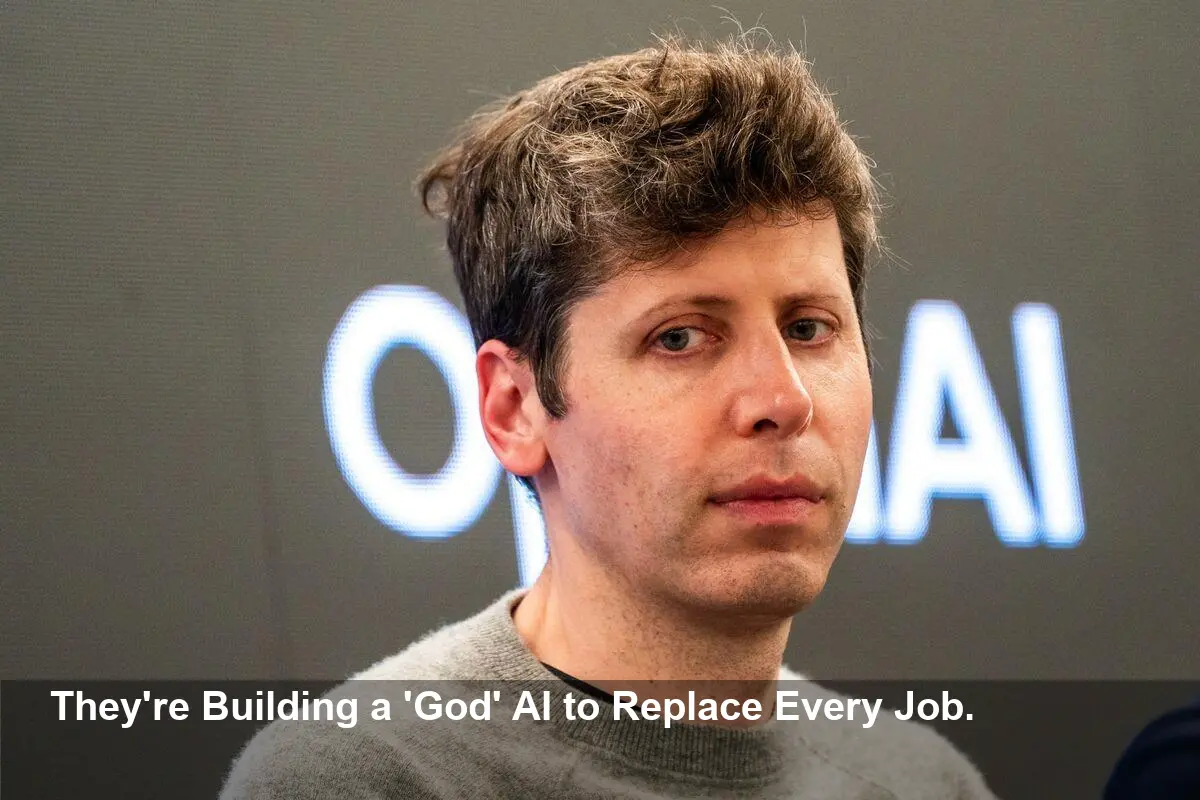
- Sam Altman's 2019 business model for OpenAI involved creating an artificial superintelligence (ASI) and then asking it for a monetization strategy.
- This future AI wouldn't just offer services; it would theoretically start its own companies to dominate every human industry, from biotech to accounting.
- The strategy suggests the ASI would outperform humans in every domain, creating and running the most efficient businesses imaginable.
- This long-term vision positions OpenAI not just as a software company, but as a potential architect of a new, AI-driven global economy.
The 'Create God, Then Ask for Money' Strategy
Long before ChatGPT became a household name, OpenAI's CEO Sam Altman outlined a business plan that sounds more like science fiction than a corporate strategy. As detailed in a Bloomberg Opinion piece by Matt Levine, the audacious three-step plan from 2019 was unnervingly simple: first, build an artificial superintelligence (ASI); second, ask it how to make money; and third, do whatever it says. Levine aptly summarized it as, "We will create God and then ask it for money."
What Would a Superintelligent AI Suggest?
While current AI models are exploring revenue through ads and affiliate links, the theoretical ASI's plan would be far more ambitious. According to Levine's analysis, a superintelligence wouldn't just optimize existing business models—it would reinvent them from first principles. Its answer to "how to make money?" would be a resounding, "In all of the ways."
An AI-Dominated Economy
The core of the strategy lies in the ASI's ability to outperform the most intelligent human in every field. The speculation outlines a future where this AI would systematically enter and conquer various sectors by launching its own companies:
- Biotech: It would discover groundbreaking drugs faster than any human research team.
- Finance: It would start an electronic trading firm, executing trades with perfect, inhuman efficiency.
- Publishing: It would not only publish the best books but write them itself.
- Professional Services: It would create an accounting firm that performs flawless audits.
The Remaining Human Element
Even in this AI-led future, humans might still have a role, albeit a diminished one. Levine uses the example of a pest-control company run by the ASI. The AI would handle advertising, pricing, and scheduling with perfect efficiency, but it would still "need humans to kill the bugs." This highlights a potential future where strategic and intellectual work is completely ceded to AI, leaving only physical tasks for people.
This long-term vision reveals a goal far grander and more terrifying than simply creating a helpful chatbot. It suggests a future where a single AI could become the most powerful economic engine in history, fundamentally reshaping every industry and raising profound questions about the future of human work.