Mercedes’ Drive Assist Pro: CLA Demo Handles Surface Streets

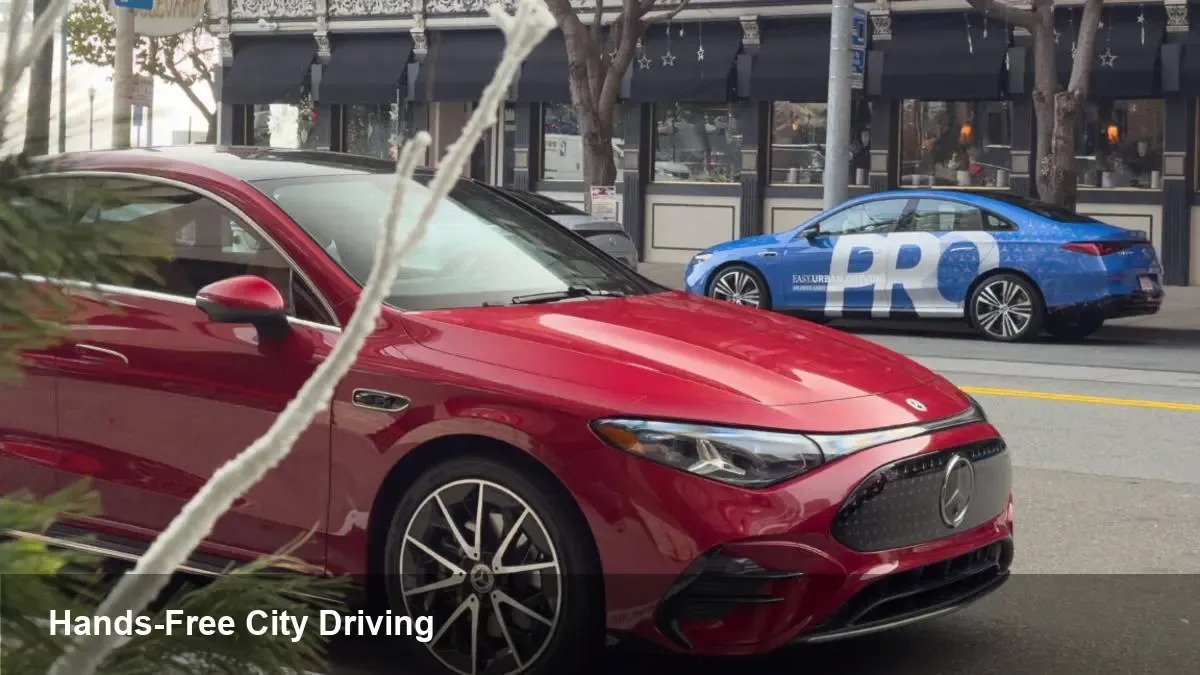
- Key Takeaway 1: Mercedes’ Drive Assist Pro handled point-to-point driving on surface streets in a San Francisco demo, reading stop signs, lights and speed bumps.
- Key Takeaway 2: The system runs on a software-defined vehicle (SDV) architecture using Nvidia Orin and an end-to-end AI stack with rules-based safety guardrails.
- Key Takeaway 3: Mercedes says US safety certification is complete; Drive Assist Pro will arrive on the CLA late this year and expand as more models get SDV upgrades.
- Key Takeaway 4: The human driver remains responsible — Mercedes positions the system as an advanced Level 2+ assist with tight geofencing and redundant sensors.
What Drive Assist Pro can do
Drive Assist Pro extends Mercedes’ adaptive cruise and lane-keeping tech to lower-speed, city driving. In a recent on-road demo in San Francisco’s downtown, the system completed a 20-minute point-to-point route without human intervention.
The car identified traffic lights, stop signs, speed bumps, construction zones and double-parked vehicles, and it planned lane changes ahead of time to reach a given destination.
How it feels on the road
The demo CLA behaved conservatively and legally — the system takes full stops at stop signs and yields appropriately. Small driver inputs, such as a light brake tap, don’t cancel the assist, allowing a collaborative human–machine driving style.
Drivers may notice slower-than-human reactions in some cases, such as complete stops at intersections, but that is by design: Mercedes emphasizes safety and predictability over aggressive driving.
Technology under the hood
Drive Assist Pro is built on a software-defined vehicle architecture with four consolidated compute domains rather than many discrete ECUs. Perception and path planning are handled by Nvidia’s Orin platform.
Mercedes has shifted from a predominantly rule-based stack to an end-to-end AI model. As Chief Software Officer Magnus Östberg put it: “We completely elevated our autonomous driving stack. It is no longer on a rule-based stack.” The company tokenizes inputs and candidate trajectories, then applies a rules-based safety layer to catch any AI mistakes before they are executed.
Safety and redundancy
Mercedes pairs multiple sensor modalities — cameras, radar and other sensors — with a safety guardrail that enforces legal and conservative behavior. That hybrid approach is intended to avoid single-modality failure modes associated with camera-only systems.
Availability and regulation
Drive Assist Pro has launched in China and, according to Mercedes, has completed US safety certification. The CLA will be first in line in the US late this year, with other models receiving the feature as they undergo SDV upgrades.
European deployment will depend on regulatory changes in that region. Mercedes continues to offer full human oversight for now, positioning Drive Assist Pro as an advanced, safety-first driver assist rather than autonomous driving without supervision.