Lyria 3 Arrives in Gemini: 30-Second AI Music Made Easy

What Lyria 3 in Gemini means
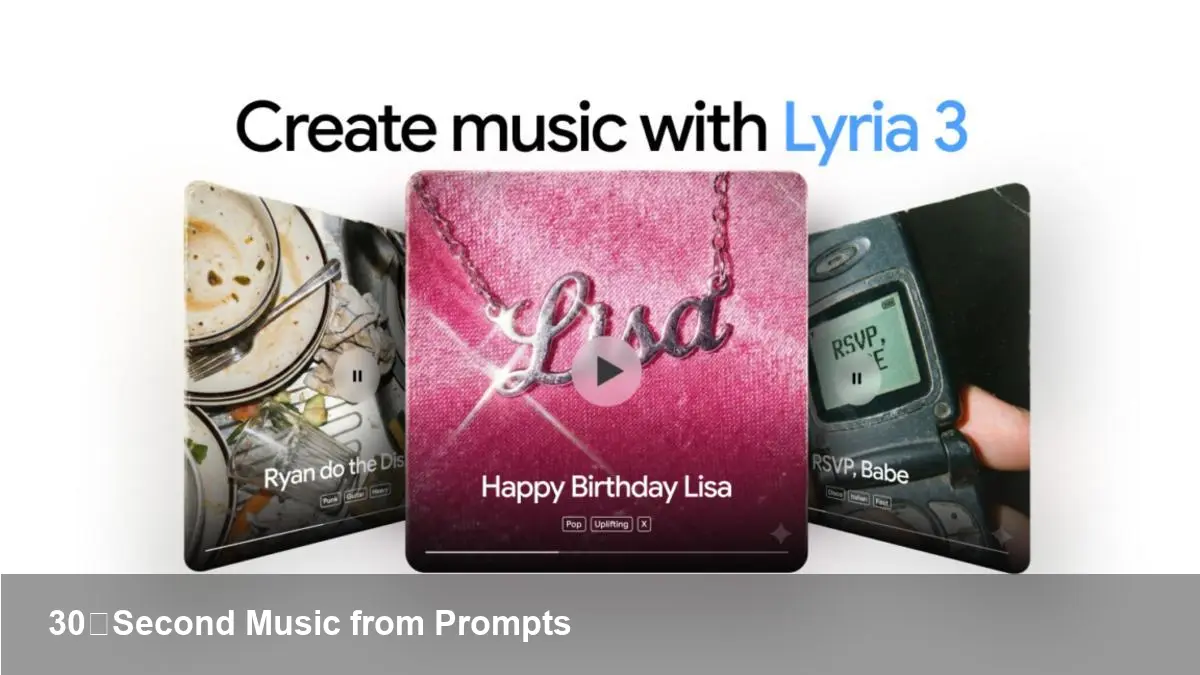
Google has started rolling Lyria 3 into Gemini, making short music generation from text prompts available directly in its flagship AI environment. The headline: with a simple prompt you can produce roughly 30 seconds of generated music. That may sound modest, but it changes how creators, developers, and small teams prototype audio.
This piece explains what to expect from Lyria 3 in Gemini, how teams can use it today, and what to watch for as AI music moves from experiment to everyday tool.
Brief background: Google, Gemini and the Lyria line
Google has been working in audio generation for years. Gemini is Google’s broader conversational and multimodal AI platform that bundles language, vision, and now audio generation capabilities. Lyria 3 is the latest music-oriented model in Google’s family of generative audio systems. Unlike big, studio-focused tools, Lyria 3’s immediate pitch is accessibility: type a prompt and get a short piece of music in return, right inside Gemini.
Why 30 seconds? Short clips are small from a compute and moderation perspective, easier to iterate with, and useful for many practical needs—background loops, sound beds for videos, prototypes for games and ads.
Practical use cases and concrete scenarios
- Indie game developer: Ship a prototype level with a generated ambient loop. Instead of waiting days for a composer, a dev types: “mysterious synth pad, 80 BPM, subtle arpeggio, 30s loop suitable for exploration” and drops the output into the build to test feel.
- Small marketing studio: Quickly generate multiple jingle concepts for an ad each under 30 seconds to present to a client. Iterate on mood and instrumentation with a few prompts instead of booking studio time.
- Podcaster or vlogger: Create short intro/outro beds tailored to episode tone—happy ukulele, mellow electric piano, or energetic lo-fi beat—without licensing search.
- UX experiments: Voice assistants or apps that need dynamic background music can generate short clips on the fly to match user mood or context.
These are realistic, immediate applications where a 30-second limit is often enough and where speed matters more than final mastering quality.
How developers and creators can work with it (workflow tips)
- Start with tight prompts: Include instrumentation, mood, tempo, and intended use (loop, bed, lead) for better results. Example: “30s acoustic guitar loop, laid-back, 90 BPM, for travel vlog intro.”
- Iterate quickly: Try 3–5 variants, then choose one to refine. Use adjectives and references (e.g., “in the style of 90s trip-hop” as a prompt hint—be mindful of copyright/legal constraints when referencing living artists).
- Layer and edit: Treat Lyria 3 outputs like raw sketches. Drop them into a DAW, EQ, add effects, or chop to make loopable sections. Many creators will combine a generated bed with human-played leads.
- Combine with generative tooling: Use Gemini’s text outputs to script variations, create timestamps/labels for generated clips, or produce metadata (mood tags, suitable use cases) for cataloging.
- Automation: For apps that need many short clips (games, ads, dynamic soundtracks), script prompt generation and moderation checks. Cache outputs to avoid repeated generation costs.
Business value and productivity impact
- Faster prototyping: Product and creative teams can test multiple sonic directions in hours instead of days. This reduces iteration time and decision friction.
- Cost efficiency: Small teams gain access to a class of audio creation without upfront studio costs. For early-stage startups and indie creators, that’s a meaningful reduction in production overhead.
- New product features: SaaS products (editing apps, game engines, podcast hosts) can add on-the-fly music generation as a differentiator.
- Democratization vs. commoditization: More people can create basic music beds, which lowers the barrier to entry—but may also compress the market for cheap stock music.
Limitations, risks, and practical constraints
- Length and musicality: Lyria 3’s 30-second focus means it’s geared to sketches, loops, and brief beds—not full-length songs or fully produced tracks.
- Quality variance: Generated music can be impressive at times and bland or incoherent at others. Expect to treat outputs as rough material requiring human refinement.
- Copyright and ethical questions: Prompts that explicitly imitate living artists raise legal and ethical concerns. Companies and creators should keep track of any usage policies Google publishes and consider licensing implications if they intend commercial release.
- Moderation and safety: Generated audio still needs checks for inappropriate content, or accidental reproduction of copyrighted material. Build moderation and provenance tracking into workflows.
- Ownership and licensing: Confirm the terms under which generated audio may be used commercially. For commercial products, don’t assume unrestricted rights without checking Google’s licensing terms for Gemini/Lyria outputs.
What to expect next: three implications for the near future
- Deeper DAW integration: Expect plugins or APIs that let producers generate and place 30s stems directly inside common DAWs, making AI generation part of the session rather than a separate tool.
- Longer-form and multi-track models: As compute and moderation evolve, models will likely handle longer pieces and produce separate stems (drums, bass, leads) for easier mixing.
- Rights frameworks and marketplaces: We’ll probably see clearer licensing tiers and marketplaces for AI-generated music—some free for prototyping, premium licensing for commercial release—along with metadata standards to track provenance.
How to adopt Lyria 3 responsibly today
- Use it for ideation and prototyping first; back promising pieces with human composition or licensing if releasing commercially.
- Keep prompt and output logs for provenance and auditing.
- Respect artist acknowledgement and avoid prompting for exact reproductions of living artists.
- Factor moderation and quality checks into any product that will generate audio at scale.
Lyria 3 in Gemini is a pragmatic step: short, immediate audio that fits naturally into rapid creative workflows. For teams that need fast musical experiments—game devs, marketers, podcasters—it opens new shortcuts. For professional music makers, it’s a tool for ideation rather than replacement. As the tech matures, the meaningful questions will be around ownership, quality improvements, and how creators incorporate AI as a standard part of their process.