Gemini Powers Google Translate for Natural, Live Translations

What changed and why it matters
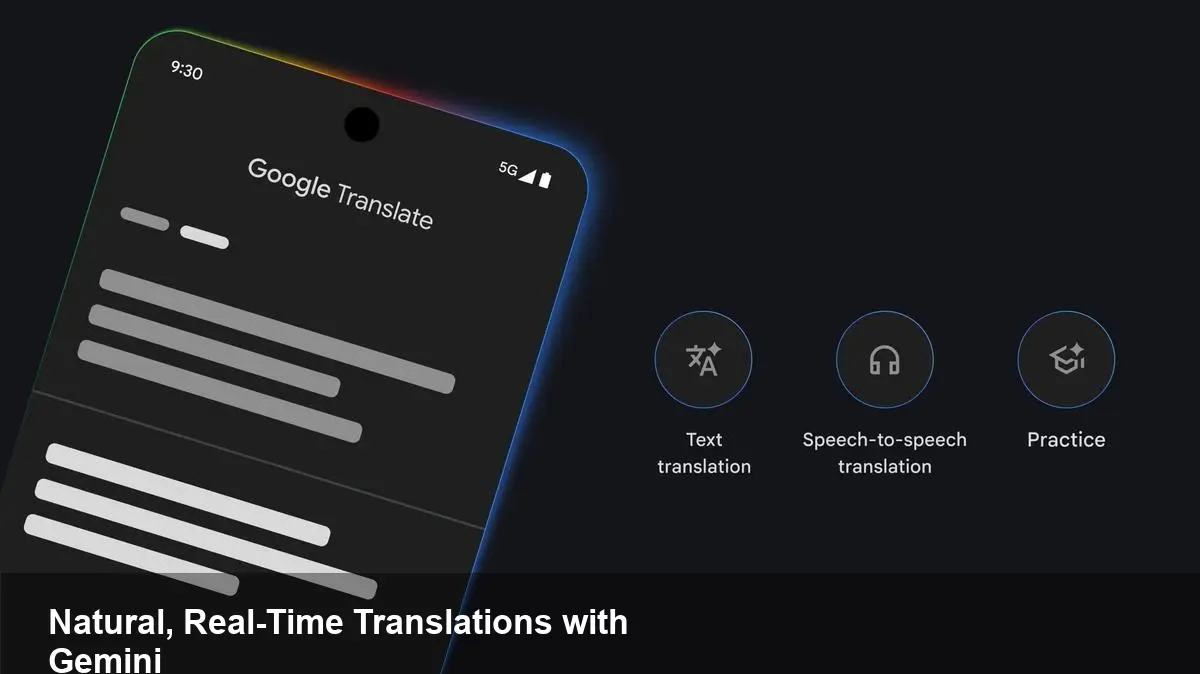
Google has started folding its Gemini large language model into Google Translate and the Translate mobile app, bringing more context-aware AI into everyday translation. That means the service will try to move beyond literal, word-for-word conversions toward phrasing that preserves idioms, tone, and implied meaning. Google also extended the capability to real-time headphone translation, which aims to make live conversations across languages smoother.
For regular users this feels like more natural-sounding translations. For developers and businesses, it's the start of a shift in how machine translation can be used in product flows, customer support, and in-person experiences.
A quick background on Gemini and Google Translate
Gemini is Google’s next-generation multimodal model family designed to handle text and other inputs with more nuance than earlier neural translation systems. Google Translate has long relied on deep neural networks and massive bilingual corpora; integrating Gemini layers in the pipeline adds conversational context understanding and better disambiguation for phrases that change meaning depending on usage.
The integration is rolling into consumer-facing products, notably the Translate app and on-device features that power headphone translation, rather than being limited to static web-based translations.
Real-world scenarios where you'll notice the difference
- Traveler negotiating in a busy market: Instead of a literal translation of a bargaining phrase, Gemini-infused Translate can produce a culturally appropriate equivalent that preserves intent (politeness, humor, urgency).
- Remote standup with mixed-language teammates: Live headphone translation reduces friction in meetings by preserving casual or idiomatic expressions, so a phrase like “we’ll circle back” doesn’t get translated into something confusing in another language.
- Localization workflow for a startup: Machine suggestions from Gemini can propose idiomatic UI strings that require less editing, speeding up time-to-market for multilingual releases.
These are practical improvements: fewer awkward or misleading translations, and better fluency when context matters.
How the headphone translation use case works (and the technical trade-offs)
Real-time headphone translation needs very low latency to feel conversational. That can be implemented in two ways:
- Cloud-assisted processing: audio is streamed to servers running the model, processed, and the translated audio or text is streamed back. This usually yields the best accuracy but depends on a reliable, low-latency network and raises privacy considerations.
- On-device or edge processing: models run locally on the phone or headset, minimizing latency and exposure of audio to cloud servers. This is better for privacy and offline usage but requires optimized, smaller models or specialized silicon.
Gemini’s integration suggests Google is mixing approaches: using cloud power for harder cases while supporting accelerated on-device components for responsiveness. For users, that means better quality when connected and safer, faster fallback when offline.
Implications for developers and product teams
- Translation-as-UX, not just text conversion: Teams should start thinking of translation as part of the user experience. Context-aware translations let you maintain brand voice and tone across languages; that requires design and QA processes that treat machine output as a first pass rather than a finished product.
- Lowers barrier for rapid localization: Startups can iterate faster on multilingual features if initial translations are more idiomatic. That reduces time and cost in early stages, but human review remains essential for marketing copy, legal text, and domain-specific content.
- Integration opportunities: Expect Google Cloud translation APIs and SDKs to evolve to expose richer context signals (conversation history, user role, tone preferences). Developers should plan for new parameters and flows to send context alongside strings for translation.
Where Gemini-enhanced translation won't be a silver bullet
- Accuracy-sensitive domains: Medicine, legal, and regulated communication still require human expertise. AI can speed drafting but cannot replace certified translation in high-stakes contexts.
- Rare languages and dialects: Improvements will likely be concentrated in languages with abundant training data. Less-resourced languages may see slower gains.
- Cultural nuance and bias: Models can misinterpret cultural subtext or reproduce biased phrasing. Organizations should maintain human oversight and diverse review panels for sensitive content.
Business value and cost considerations
Integrating smarter translation into products creates measurable business value: faster onboarding for international users, reduced localization costs, and improved customer satisfaction for multilingual support. However, there are operational costs and trade-offs:
- Compute and API costs for cloud translation or real-time streams
- Investment in privacy compliance and consent flows for audio streaming
- Ongoing annotation and human-in-the-loop review to catch errors and tune style
For many teams, the sweet spot will be hybrid workflows where Gemini provides fluent first drafts and human linguists validate or polish output.
Two technical and strategic trends to watch
- Edge translation and specialized silicon: As wearables and earbuds become translation endpoints, expect more attention on model efficiency and hardware-accelerated inference. That will make low-latency, private translation more common.
- Translation as part of multimodal assistants: Combining translated text with images, context from calendars or emails, and conversational history will let assistants provide responses that feel native rather than literal. This will change the expectations for multilingual virtual assistants and search.
Practical advice for teams and travelers
- Travelers: Use real-time headphone translation for casual conversation and navigation, but have backup options (phrasebook, human translator) for critical interactions.
- Product teams: Treat Gemini output as a high-quality draft. Build review steps for brand voice, legal compliance, and cultural sensitivity. Instrument translations so you can measure user impact and error rates.
- Developers: Prepare for richer translation APIs by structuring context data (conversation ID, role, prior messages) and by designing fallbacks for offline or high-latency networks.
Gemini's arrival in Google Translate is a pragmatic step toward more human-like machine translation. It won't remove the need for human expertise where it matters most, but it will change how teams approach multilingual design and how people interact across language barriers every day. What's your biggest translation pain point today—and could a context-aware model solve it for you?